
 Español
 عربى


-
View More
 OE NUMBERS:
YC1W4684AA
4393343 -
View More
 OE NUMBERS:
7L0521403
95542101000 -
View More
 OE NUMBERS:
4165078
7W4684AA -
View More
 OE NUMBERS:
0521307 | 0521307A
0521307S1 | 0521307AS1 -
View More
 OE NUMBERS:
0521307 | 0521307A
0521307S1 | 0521307AS1 -
View More
 OE NUMBERS:
0521127 | 0521127A
0521127S1 | 0521127AS1 -
View More
 OE NUMBERS:
99642102051 | 99642102051SK
99642102050 | 99642102050SK | 99642102050S2
99642113701 | 99642113701SK | 99642113701S2
99742142050 | 99742142050SK
99742102050S2


Business For 17 Years
ABOUT LIANJUN
Anhui Lianjun Rubber Technology Co., LTD., formerly Wenzhou Lianjun Vehicle Parts Co., LTD., was founded
in 2009, referred to as "Lianjun Rubber". Lianjun Rubber is located in Ningguo city, Anhui
province—automobile NVH rubber damper production base, the factory covers an area of 13,000 square
meters, close to Hangzhou city (less than 100km).Lianjun Rubber focusing on NVH rubber damper elements
of R&D, manufacturing and sales for Mercedes-Benz and BMW chassis systems. Anhui Lianjun Rubber Technology Co., LTD. is China custom Automotive Driveshaft Coupling Plate Manufacturers and Driveshaft Coupling Plate For Other Models Factory, we offer Universal Driveshaft Coupling Plate for sale.Its main products are Engine
mounts, Drive shaft support bearing, Transmission mounts, Support drive shaft, Sturt mounts, Bushing and
other series of auto rubber material products, nearly 1000 specifications. Lianjun Rubber is
committed...
MORE ABOUT US
-
AREA0
Established in 2009
-
AREA0㎡
Floor area
-
HAVE0
Product Specifications
Certificate Of Honor
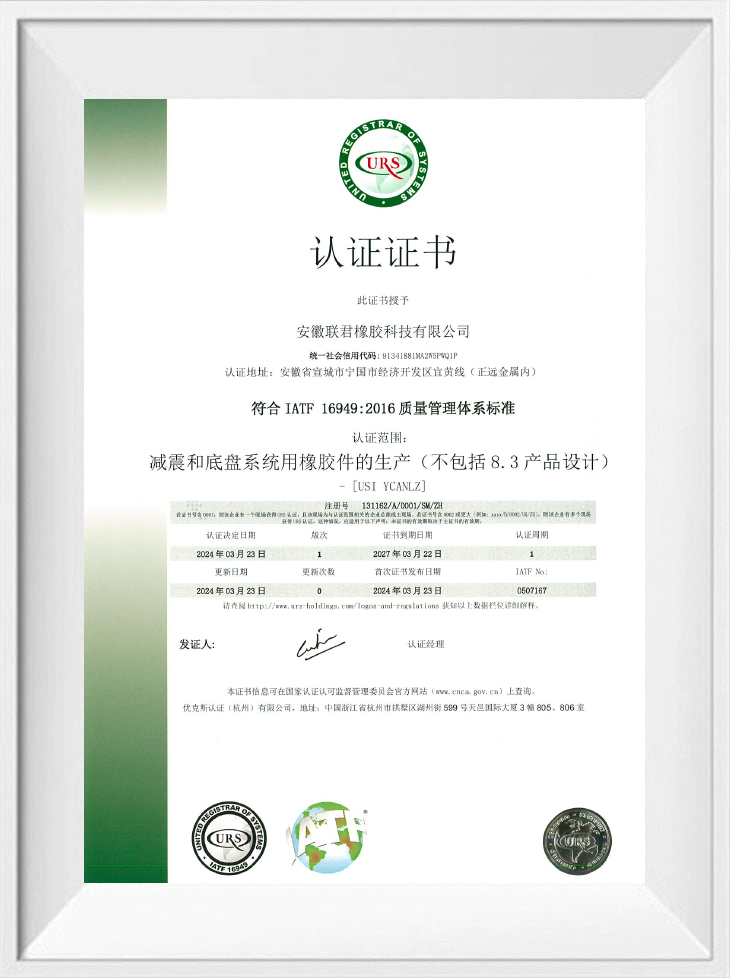
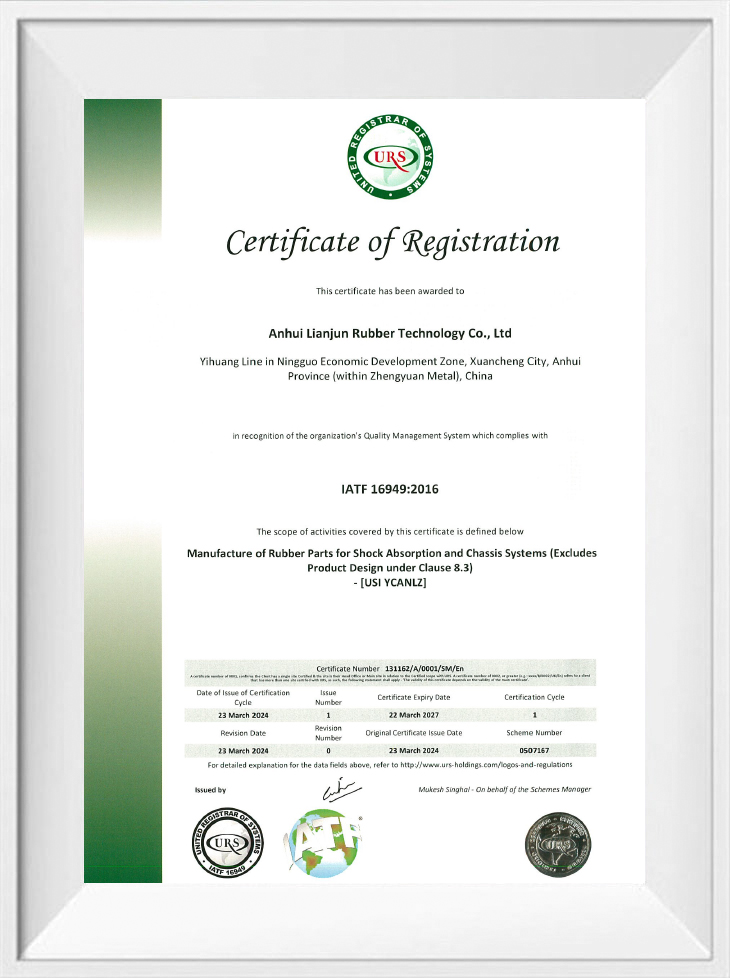
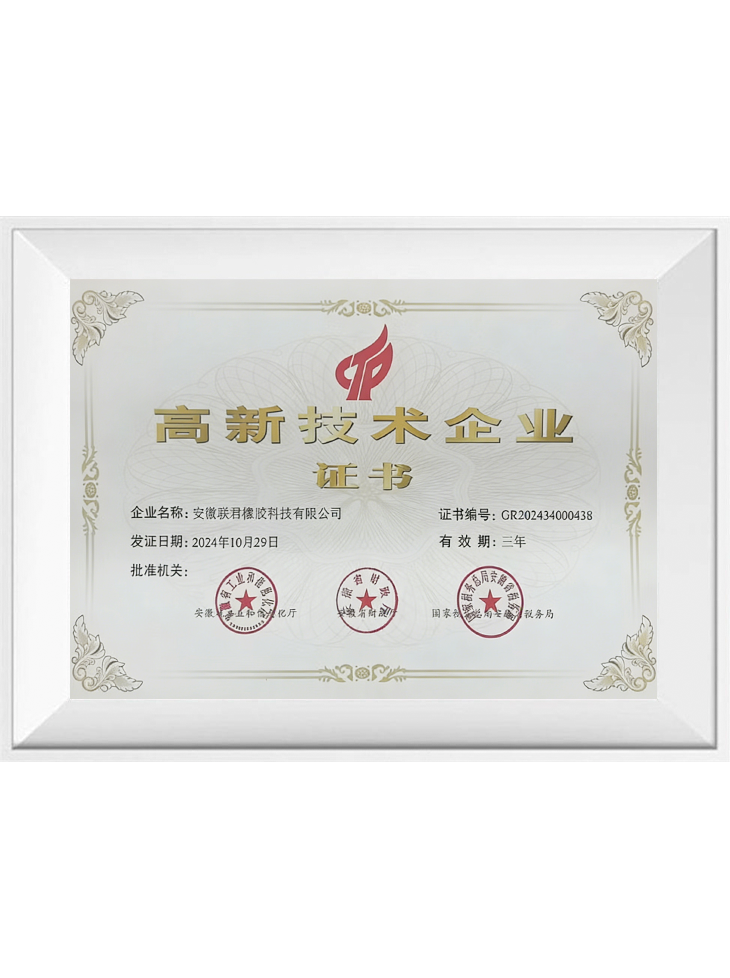
News
-
A warranty-returned center support bearing seldom arrives with a seized ball bearing. Open the box and you usually find a bearing that still spins smoothly, sitting inside a rubber ring that is split, swollen, or separated from its steel shell. That single detail explains most of the failures reported on Mercedes-Benz...
-
A workshop takes in a 2011 BMW 535i with a complaint that has already survived two wheel balances and one wheel bearing replacement: a low, hollow drone that appears at roughly 45 mph, fades above 60 mph, and never changes when the engine is revved in neutral. The part responsible is bolted to the floor pan, costs les...
-
Exhibition Name Automechanika Frankfurt 2026 Date September 8 – September 12, 2026 Venue Ludwig-Erhard-Anlage 1, D-60327 Frankfurt am Main, Germany Booth No. 10.2E12 Lianjun Rubber's booth at Automechanika Frankfurt 2026 (Booth 10.2E12) Grand Industry Presence in Frankfurt From September 8 to 12, 2026, Automecha...
-
Showcasing Excellence at Auto Parts Expo 2026: Anhui Lianjun Rubber Technology Deepens Expertise in High-End Automotive NVH Anti-Vibration Solutions From September 3 to 5, 2026, the 2026 Wenzhou Auto Parts Exhibition & China Auto Parts Specialty Factory Exhibition was grandly held at the Wenzhou International Con...
-
A 2013 Mercedes-Benz E-Class arrives with two complaints that sound unrelated: the steering wheel shivers at idle, and the front end clunks over broken pavement. The first comes from a collapsed engine mount sitting under an oil leak. The second comes from a control arm bushing whose rubber has separated from its stee...
-
A technician orders a carrier bearing for a BMW X5 E53 and opens a box that contains a small rubber-and-steel bracket with a bearing pressed inside. He expected something that looked like a wheel hub. The order was correct, the part was correct, but the name on the invoice did not match the picture in his head. The sh...
-
A repair order that says only "replace bushings" cannot tell a parts counter which number to pull. On a BMW E46 front lower control arm, the front position typically carries a solid rubber press-fit bushing, while the rear position on E39 and E38 arms often uses a hydraulic bushing with an internal fluid chamber. Same...
-
How Suspension Bushings and Strut Mounts Affect Vehicle Ride and Handling Every chassis relies on a small set of rubber-to-metal components to keep control arms, subframes, and struts working together without transmitting harshness into the cabin. When these parts wear out, the symptoms rarely look like a suspension p...
-
The Overlooked Components Behind Every Precise Turn When a car starts to feel vague through a corner, most owners look first at tires and wheel alignment. Yet a large share of steering complaints trace back to two parts that rarely get inspected on their own: the strut mounts at the top of the front suspension and the...
-
A worn strut mount rarely announces itself with a single obvious symptom. Instead, it shows up as a faint knock over speed bumps, a slightly looser feel through the steering wheel, or a noise that only appears when the front wheels are turned close to full lock. Because the part sits at the top of the suspension tower...
-
How Suspension Bushings Function in Daily Driving Every control arm, sway bar link, and subframe mount on a modern vehicle relies on a bushing to separate metal from metal. These small rubber or hydraulic components absorb road shock, dampen vibration, and allow the suspension to move through its full range of travel ...
-
According to its usage location, it can be divided into seven categories: engine series, drive device, control device, front and rear suspension, vehicle body, exhaust system, and other systems. Its main function is to absorb and reflect the vibration energy generated by the vibration source, and to prevent resonance e...
-
The BMW chassis system consists of three main parts: lateral (steering), longitudinal (braking), and vertical (suspension), which are coordinated and controlled by the SAM module. At the same time, the ICM system optimizes and collaborates with the dynamic driving system.The following are detailed information for each ...
Coupling Plates For Other Models Industry knowledge
Anhui Lianjun Rubber Technology Co., LTD. is a China Custom Driveshaft Coupling Plate For Other Models Manufacturers with a focused production program for NVH rubber damper elements. Within the Driveshaft Flex Disc Kit range, our coupling plates for other models cover Jaguar, Porsche, Audi, Volkswagen, BMW and Lexus applications where the original flex disc is not part of the standard Mercedes-Benz or BMW series. Each plate is produced to match the OE reference geometry, bolt circle, thickness and rubber hardness so the driveshaft assembly retains its designed torsional stiffness and vibration isolation.
Our factory in Ningguo, Anhui province operates on a 13,000 m² site and supports nearly 1,000 specifications across engine mounts, transmission mounts, strut mounts, bushings and driveshaft components. For procurement managers and plant engineers sourcing replacement coupling plates, we supply free samples, OE-number cross-referencing and batch-level quality documentation before shipment.
Coupling Plate Range for Non-Standard Models
The coupling plates in this category are configured for vehicle platforms outside the dedicated Mercedes-Benz and BMW flex disc lines. We maintain tooling and production data for the following application groups:
- Jaguar XF X250 — driveshaft rubber coupling shock absorber with OE numbers YC1W4684AA and 4393343.
- Porsche Cayenne 955 — flex disc kit and vibration absorber with OE numbers 7L0521403 and 95542101000.
- Porsche 997 Carrera & Turbo — flex disc kit covering multiple OE references including 99642102051, 99742142050 and related SK/S2 variants.
- Volkswagen Import Four-Wheel Drive — driveshaft coupling with OE numbers 0521307, 0521307A, 0521307S1 and 0521307AS1.
- Audi A3 / TT quattro / Transaxle — flex joint rubber mounts and vibration dampers with OE numbers 0521307, 0521127, 5Q0521127, 7D0521127 and 7D1521127.
- Lexus GS / LS / SC Series — driveshaft flex disc with OE numbers 37511-24010 and 37511-30020.
- BMW transmission-to-driveshaft — flex disc rubber coupling with OE numbers 4165078 and 7W4684AA.
Application Fit and Material Selection
A driveshaft coupling plate operates at the interface between the transmission output flange and the propeller shaft. The rubber element must absorb angular misalignment, damp torsional vibration and withstand repeated shear loading without cracking or delaminating from the metal inserts. We select the rubber compound and reinforcement cord layout according to the working torque, operating temperature and expected service interval of each vehicle platform.
Material considerations we apply during configuration: natural rubber or high-damping synthetic blends for NVH performance; heat-resistant compounds for close-coupled exhaust or transmission tunnel installations; embedded steel or aluminum bushings for bolt-hole reinforcement; and cord or fabric reinforcement where high torque peaks are expected.
Critical Specifications We Match
Each coupling plate is produced against a defined dimensional and material specification. The following parameters are verified during production and final inspection:
| Parameter | What We Control |
|---|---|
| Bolt circle diameter | Matched to the transmission flange and driveshaft yoke pattern for each OE reference |
| Plate thickness | Controlled to maintain correct preload and angular travel |
| Rubber hardness | Selected per platform to balance vibration isolation and torsional stiffness |
| Bolt-hole reinforcement | Steel or aluminum sleeves to prevent rubber creep and maintain clamp load |
| Bond integrity | Rubber-to-metal adhesion verified through destructive sample testing per batch |
Configuration and Customization Approach
When a customer requires a coupling plate for a model not listed in our standard catalog, we work from the OE reference number, sample part or dimensional drawing. Our R&D team evaluates the existing tooling library first; if no matching mold exists, we prepare a new mold based on the submitted geometry and material requirements. Free samples are provided so the customer can verify fitment, hardness and bolt-hole alignment before committing to a production order.
For distributors and project managers handling mixed-model orders, we consolidate multiple coupling plate references into a single shipment and provide per-reference packing lists with OE cross-reference labels.
Quality Assurance and Acceptance
Our quality control system operates according to ISO9001 requirements, with IATF 16949-aligned process controls for automotive rubber components. Each production batch of coupling plates undergoes:
- Dimensional inspection against the approved drawing or OE reference sample
- Rubber hardness testing on cured samples
- Visual inspection for surface defects, flash and insert alignment
- Bond integrity verification through destructive pull testing on sample pieces
- OE number and batch traceability marking on packaging
Information We Use to Configure Your Solution
To prepare an accurate quotation and production plan for a coupling plate, we require the following project inputs:
| Input | Why We Need It |
|---|---|
| Vehicle make, model and year | Confirms the correct OE reference and platform-specific geometry |
| OE number or sample part | Enables exact cross-referencing and tooling selection |
| Required quantity | Determines production batch size, mold allocation and unit pricing |
| Target delivery schedule | Aligns production planning with your project timeline |
| Packaging and labeling requirements | Supports distributor branding, OE cross-reference labels and export documentation |
Related Product Lines
Coupling plates are often sourced together with adjacent driveline and chassis components. We supply the following related categories from the same production facility:
Driveshaft Flex Disc Kit Driveshaft Support Bearing Transmission Mount Engine Mount
Frequently Asked Questions
Can you produce a coupling plate for a vehicle model not listed on your website?
Yes. We work from the OE number, a sample part or a dimensional drawing. Our R&D team checks the existing mold library first; if no matching tooling exists, we prepare a new mold and provide free samples for fitment verification before production.
What OE numbers do you cover in the Coupling Plates For Other Models category?
The current range includes Jaguar YC1W4684AA and 4393343, Porsche 7L0521403 and 95542101000, Porsche 997 series references, Volkswagen 0521307 and 0521127 families, Audi 5Q0521127 and 7D0521127, Lexus 37511-24010 and 37511-30020, and BMW 4165078 and 7W4684AA.
Do you provide free samples before a bulk order?
Yes. We support free sampling so you can verify fitment, rubber hardness, bolt-hole alignment and overall quality before committing to a production quantity.
What quality certifications apply to your coupling plates?
Our quality management system operates according to ISO9001 requirements, with IATF 16949-aligned process controls for automotive rubber components. Each batch undergoes dimensional inspection, hardness testing and bond integrity verification.
Can you consolidate multiple coupling plate references into one shipment?
Yes. For distributors and mixed-model projects, we consolidate multiple references into a single shipment with per-reference packing lists and OE cross-reference labels to simplify receiving and warehouse allocation.
If you are interested in our products, please consult us
CONTACT DETAILS
- Address : Yihuang line, Ningguo Economic and Technological Development Zone. Xuancheng City,Anhui Province.
- Fax : +86 13906874997
- Tel: +86-15856310524
- Email: [email protected]
PRODUCTS
QUICK LINK
Hot Search
MOBILE TERMINAL
Copyright © ANHUI LIANJUN RUBBER TECHNOLOGY CO., LTD.
All Rights Reserved.
Custom Universal Driveshaft Coupling Plate Factory
