
 Español
 عربى


Automotive Rubber Bushing Types Explained: Function, Construction, Material
Content
- 1 Why Bushing Types Are Sorted Three Ways
- 2 Bushings That Locate the Chassis
- 3 Bushings That Isolate the Powertrain and Driveline
- 4 Construction Types: Reading the Cross Section
- 5 Solid Rubber, Voided Rubber, or Hydraulic Fluid
- 6 Symptom to Likely Bushing Type
- 7 Matching a Bushing to the Chassis: A Six-Point Check
- 8 Frequently Asked Questions
A repair order that says only "replace bushings" cannot tell a parts counter which number to pull. On a BMW E46 front lower control arm, the front position typically carries a solid rubber press-fit bushing, while the rear position on E39 and E38 arms often uses a hydraulic bushing with an internal fluid chamber. Same arm, different construction, different failure mode, different part number.
So the practical way to explain automotive rubber bushing types is not one long list. Three axes decide almost everything: function (where the part sits in the load path), construction (how rubber and metal are joined), and damping medium (solid rubber, voided rubber, or hydraulic fluid).
Answer all three and fitment, ride quality, and service life usually line up. Miss one and the noise often returns within a few thousand kilometers, with the customer convinced the new part was defective.
Why Bushing Types Are Sorted Three Ways
Each axis answers a different question a technician or buyer has to settle before an order goes out.
- Function: what motion the bushing permits and what load it carries, whether radial, axial, torsional, or a mix. A stabilizer bar bushing mainly lets the bar rotate; a control arm bushing has to twist through the full suspension travel.
- Construction: how the rubber is held, from bonded rubber-to-metal and press-fit outer steel sleeves to floating sleeves and two-piece sandwich designs with a separate inner core.
- Damping medium: solid rubber, rubber with tuned voids, or hydraulic fluid pushed through an orifice to damp small movements that solid rubber passes straight through.
The axes also explain price gaps. A hydraulic cradle bushing for a W221 S-Class contains a fluid chamber and an orifice plate; a solid rubber bushing for a W201 190E does not. Even when bore and bolt spacing look close, the two behave differently in the car.
Bushings That Locate the Chassis
These parts hold geometry: they keep the arm, cradle, or bar in position while absorbing road input.
Control arm bushings
Front lower control arm bushings take braking and acceleration loads plus torsional twist as the arm swings. The solid rubber press-fit type is durable and transmits slightly more sharpness into the cabin; the hydraulic type adds a fluid chamber for low-amplitude isolation, which is why it appears on heavier and comfort-focused models. Wear shows as a knock over small bumps, vague steering, and uneven front tire wear.
Trailing arm and subframe bushings
Trailing arm bushings handle fore-aft and lateral loads at the rear axle. Subframe, or cradle, bushings carry the mass of the whole rear assembly and are usually the largest rubber parts under the car. On hydraulic versions, a fluid trace and a collapsed gap are the clearest signs.
Stabilizer bar bushings
These work differently. The bar must rotate freely inside the bushing, so radial grip is low and bore diameter is the critical dimension. Bushings of 22 mm, 24 mm, 26 mm, and 28 mm fit the same bracket family but are separate parts. Sizing from the old bushing is risky because rubber takes a set; measure the bar itself. Split, open-type bushings are common because they can be fitted without dropping the bar.
 BMW 3 Series E46 Suspension Control Arm Bushing LJ-240Check this BMW E46 control arm bushing for suspension replacement; 48 mm length, 12 mm inner diameter, 45 mm outer diameter, OE 33306786980 and 33326786978.View Product →
When the position is clear but the number is not, working from a complete suspension bushing catalog organized by chassis code is faster than matching by photograph.
Bushings That Isolate the Powertrain and Driveline
Engine and transmission mounts
Engine mounts carry static powertrain weight and then soak up combustion-order vibration. Left and right mounts are usually different parts with different heights and rubber stiffness, and hydraulic versions are common on V6 and V8 models and on all-wheel drive applications. A torn or collapsed mount produces idle shake in the cabin and a thud when shifting from D to R.
Driveshaft center support bearings
A two-piece propshaft is supported in the middle by a bearing wrapped in a rubber ring. The rubber isolates driveline rumble; the bearing allows rotation. Once the ring sags or tears, the shaft sits slightly out of line and the car develops a thud on take-off plus a body-floor vibration at roughly 60 to 100 km/h.
 BMW X5 E53 Propshaft Center Support BearingPropshaft center support bearing for BMW X5 E53 with 30 mm inner diameter; helps address driveline vibration and maintain stability; OE 26121229726, 26127507740.View Product →
Driveshaft flex discs
The flex disc, also called a giubo, is a rubber coupling bolted between the transmission output and the propshaft. In function it is a bushing, even if the shape is a disc: it absorbs torsional shock and takes up small misalignment. Failure starts as cracking between the bolt holes and progresses to a deep, rhythmic clunk. Kits that include new bolts, nuts, and washers remove guesswork, because stretched or reused fasteners change the clamp load on the joint.
 Mercedes-Benz W201/W124 Driveshaft Rubber Coupling Flex DiscFlex disc-style driveshaft rubber coupling for Mercedes-Benz W201/W124; listed 134 mm OD, 37 mm ID, 32 mm thickness, 70 mm bolt circle, OE 2014112347.View Product →
Strut mounts, bump stops, and hangers
A strut mount is a rubber-and-bearing assembly at the top of the damper; when it fails, the symptom is a clunk over expansion joints or a springy noise when steering at a standstill. Bump stops limit suspension travel and crumble with age, which shortens damper life. Muffler hangers look trivial until a torn one lets the exhaust knock against the floor pan at idle.
Construction Types: Reading the Cross Section
Once the position is known, the cross section tells you what has to be pressed, bolted, or aligned.
- Bonded press-fit: rubber vulcanized to an outer steel sleeve, installed with a press, where orientation marks matter.
- Floating: a rubber sleeve with no steel shell, held by the bracket, often found on trailing arms.
- Two-piece sandwich: rubber sleeve plus a separate inner metal core or end plates; the bond line is the wear point.
- Hydraulic: a rubber body with a fluid-filled chamber and an orifice, which leaks and loses damping instead of cracking first.
- Ball-joint style: a near-spherical joint for steering and locating arms, judged by play rather than by surface cracks.
Orientation belongs to the type. A bonded bushing pressed in 90 degrees off still enters the arm, still passes a visual check, and still changes the handling balance. Mark the old part before removal whenever the new one has a notch, an arrow, or an offset bore.
Solid Rubber, Voided Rubber, or Hydraulic Fluid
Solid rubber
The lowest cost, the most predictable life, and the firmest of the three. A good match for older chassis, commercial platforms, and any application where the driver accepts more road noise in exchange for durability.
Voided rubber
Gaps molded into the rubber make stiffness direction-dependent: soft in one axis, stiffer in another. This is the usual choice for stabilizer bushings and many engine mounts, because it tunes isolation without adding fluid.
Hydraulic
A fluid chamber and an orifice damp small, high-frequency movement that solid rubber transmits. The trade is complexity, since the same part that quiets an S-Class cabin can leak, collapse, and cost several times more.
Replacing a hydraulic bushing with a solid one to cut cost is a decision the customer should make, not the counter. The car will still drive, but idle and coarse-surface vibration will clearly increase, and the workshop will hear about it.
Symptom to Likely Bushing Type
Use symptoms as a filter, then confirm with a pry bar or a loaded test before ordering.
| Symptom | Most likely type | First check |
|---|---|---|
| Thud when engaging D or R | Engine or transmission mount | Load the driveline with the brake held |
| Vibration at 60-100 km/h through the floor | Center support bearing or flex disc | Look for a sagging ring and cracked bolt holes |
| Knock over small bumps with tire edge wear | Control arm or trailing arm bushing | Pry the arm, check for bond separation |
| Rattle over speed bumps | Stabilizer bar bushing or link | Check the gap between bar and bushing |
| Clunk from the strut tower top | Strut mount or its bearing | Turn the steering at a standstill |
| Deep clunk with a fluid trace at the cradle | Hydraulic subframe bushing | Inspect for leaks and collapse |
A detailed walk-through of wear signs sits in the guide to symptoms of worn Mercedes-Benz and BMW suspension bushings.
Matching a Bushing to the Chassis: A Six-Point Check
Chassis codePositionConstructionKit contents
- Chassis code and platform, not just the model name: E46 differs from F30, W203 differs from W204.
- Position on the vehicle: front or rear axle, left or right, inner or outer arm.
- Construction: bonded press-fit, floating, sandwich, or hydraulic. Substituting across constructions changes both ride and service life.
- Bore or bar diameter for stabilizer parts. Measuring the bar, not the worn bushing, is the reliable route.
- Kit contents: bolts, nuts, washers, brackets, or bearing included. Flex disc kits that ship with hardware avoid reused fasteners.
- Quantity per vehicle, and whether both sides should be replaced in the same job.
Because the same bracket often accepts two or three different bushings, the part number, not the bracket, is what guarantees the ride height and the noise result.
Frequently Asked Questions
Q1: Is a driveshaft flex disc a bushing?
Yes, in function. It is a rubber coupling that absorbs torsional shock and small misalignment between the transmission and the propshaft, even though its shape is a disc with bolt holes rather than a sleeve.
Q2: Can a solid rubber bushing replace a hydraulic one?
Sometimes it fits when the dimensions and bolt pattern match, but it will not behave the same. Hydraulic bushings damp low-amplitude movement that solid rubber passes through, so expect more idle and coarse-road vibration after the swap.
Q3: How many rubber bushings does one car have?
A typical sedan carries more than twenty rubber-to-metal joints: control arms, trailing arms, cradle mounts, stabilizer bars, engine and gearbox mounts, strut mounts, and exhaust hangers. Replacing them by axle set saves labor, since the same alignment is needed either way.
Q4: Do polyurethane bushings always last longer than rubber?
They resist oil and abrasion better and hold their shape for longer, but they are usually stiffer and transmit more noise. On a comfort-focused Mercedes-Benz or BMW, that trade is often not worth it.
The short version: name the function, name the construction, name the damping medium, then order by chassis code and position. Bushings that share a bracket rarely share behavior, and a two-minute check of a bar diameter or a bond line is the cheapest part of the job.
Recommended Products
-


Rubber Driveshaft Coupling (Flex Disc) for Mercedes SL S-Class SLK
-
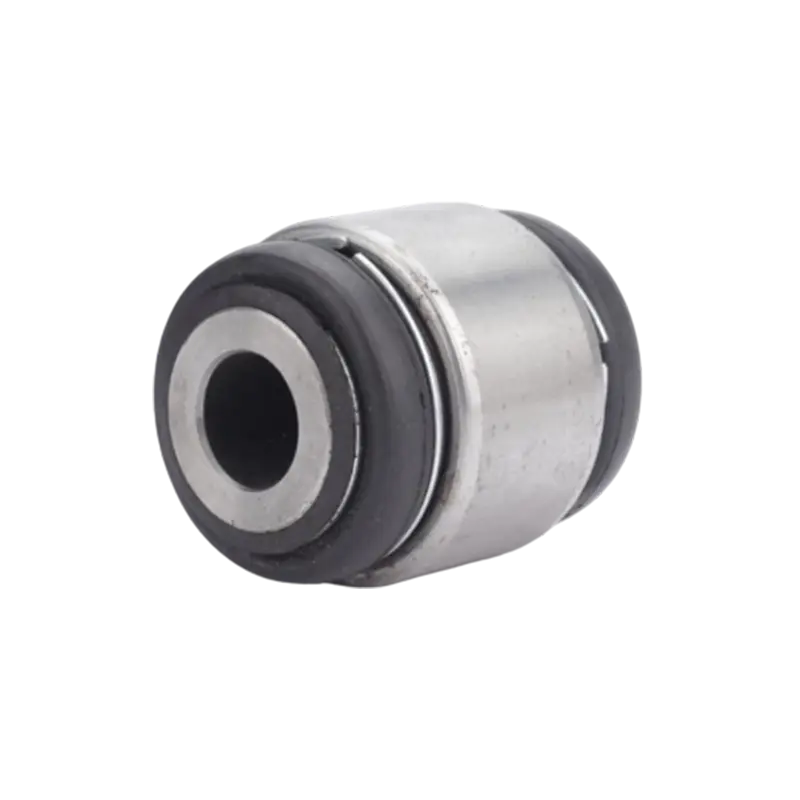
Mercedes W201/W202/W203 Control Arm Bushing Rear Suspension
-

Mercedes C-Class Driveshaft Flex Disc Vibration Dampening Rubber Coupling
-

Mercedes C-Class / E-Class Driveshaft Rubber Coupling Disc
-

Mercedes-Benz W201/W124 Driveshaft Rubber Coupling
-

Mercedes 190 (W201) Shock Absorbing Propeller Shaft Rubber Disc
Recommended News
-
Common Automotive Bushing Failure Causes: Heat, Oil, and Bond Breakdown
-
Symptoms of Worn Mercedes-Benz & BMW Suspension Bushings: When Is It Time for a Replacement?
-
Upgrading Your BMW & Mercedes-Benz Suspension: Why Strut Mounts and Bushings Matter for Handling
-
A Comprehensive Sourcing Guide for Mercedes-Benz and BMW Suspension Bushings and Strut Mounts
- Address : Yihuang line, Ningguo Economic and Technological Development Zone. Xuancheng City,Anhui Province.
- Fax : +86 13906874997
- Tel: +86-15856310524
- Email: [email protected]
Copyright © ANHUI LIANJUN RUBBER TECHNOLOGY CO., LTD.
All Rights Reserved.
Wholesale Automotive Suspension Parts Suppliers
